13. How data decay affects financial value over time
Data does not hold its value indefinitely. Customer records, market signals, and operational logs all degrade at different rates. This post explains how data decay should be factored into valuation models and ongoing data strategy.
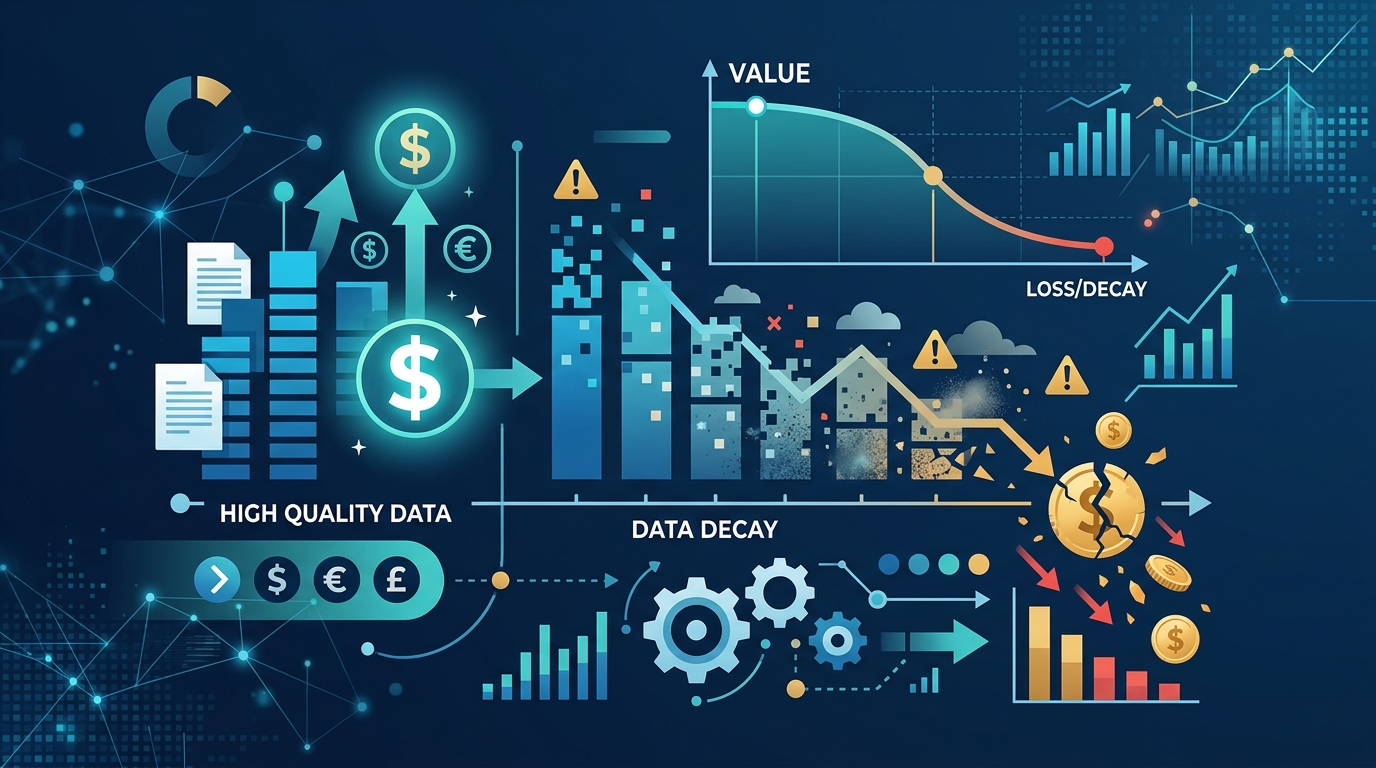
Data is often compared to physical assets, but there is one critical difference: it decays. Unlike property or equipment that may depreciate steadily, data loses relevance, accuracy, and utility at varying rates depending on its nature and context. For financial professionals and business leaders, understanding how data decay affects valuation is essential when determining the true worth of a company's information assets. A dataset that was highly valuable six months ago may be significantly less so today, and failing to account for this decline can lead to overvaluation, poor investment decisions, and missed opportunities for data hygiene.
The rate of decay depends on the type of data and how it is used. Customer contact details, for instance, degrade rapidly as people change jobs, phone numbers, and addresses. Research suggests that business contact databases can lose up to twenty percent of their accuracy each year. Transactional data may remain useful for longer, particularly when it reveals patterns or trends, but even this can become stale if market conditions shift or consumer behavior evolves. Real-time data, such as stock prices or sensor readings, can lose nearly all its value within seconds or minutes. When valuing data, it is not enough to count records or measure volume. The decay curve must be factored in, and different datasets within the same organisation may age at very different speeds.
From a financial perspective, data decay introduces risk and complexity into valuation models. If a company is valued partly on the strength of its proprietary data, investors and acquirers need to know how current that data is, how frequently it is refreshed, and what processes are in place to maintain its quality over time. A business that actively cleanses, updates, and enriches its data will see slower decay and higher long-term value. Conversely, a firm that treats data as a static archive may find that its information assets are worth far less than assumed, particularly if they have not been validated or updated in months or years. This has direct implications for mergers and acquisitions, where data quality is rarely audited with the same rigor as financial statements, yet can significantly affect post-deal performance.
Ultimately, data decay is not just a technical issue but a financial one. It affects balance sheets, investor confidence, and the sustainability of data-driven business models. Companies that recognise this and build data maintenance into their governance frameworks will be better positioned to demonstrate value, attract investment, and defend their data assets against the inevitable passage of time. Regular valuation that accounts for decay is not a luxury but a necessity in any organisation that claims data as a core asset.