17. How investors could use data valuation to compare companies
Traditional financial metrics tell only part of the story for data-driven businesses. This post examines how investors can use structured data valuation to compare companies, benchmark portfolios, and spot value that the balance sheet does not capture.
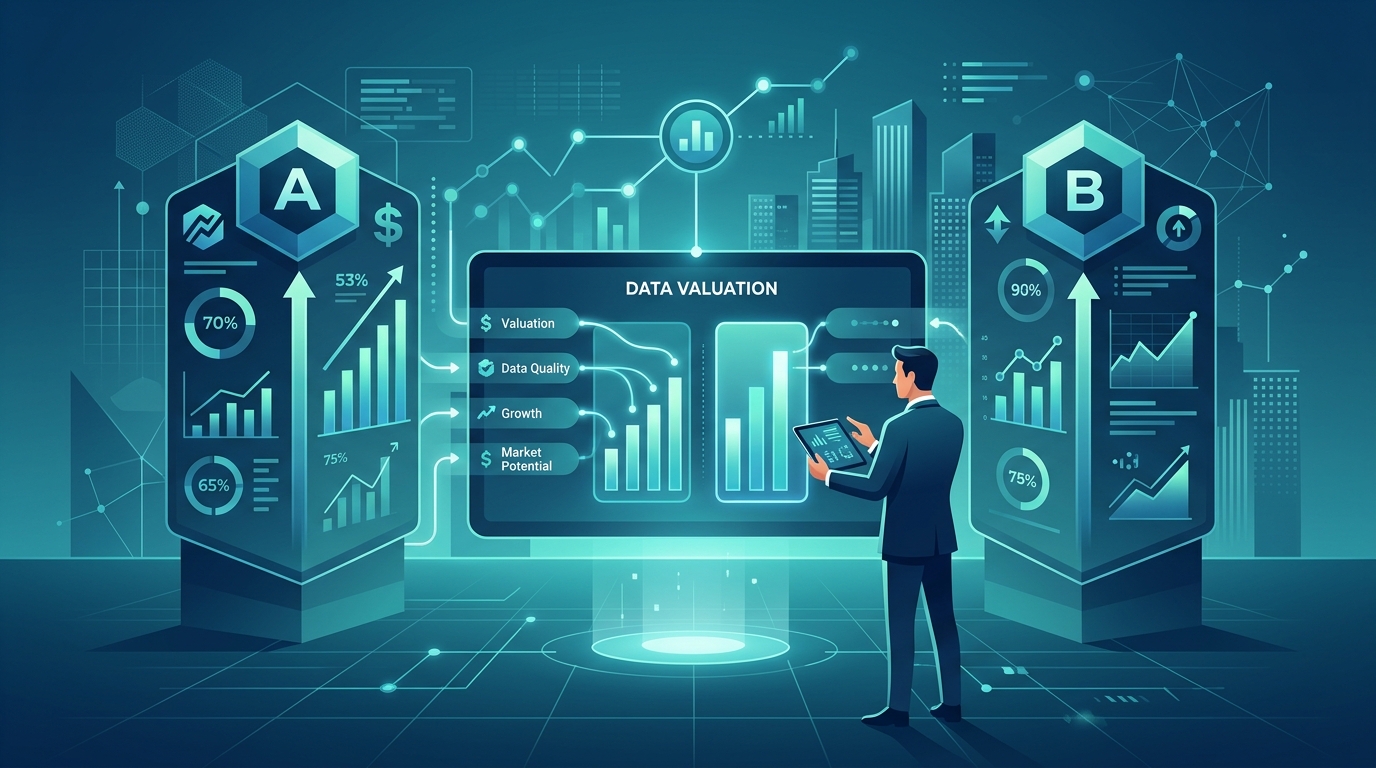
When comparing two companies in the same sector, investors traditionally rely on financial metrics like revenue, profit margins, debt ratios, and cash flow. But these measures often miss a crucial component of modern business value: the quality, scope, and strategic potential of a company's data assets. As organisations become more data-driven, the ability to systematically assess and compare data holdings is becoming an essential part of the investment decision-making process. A formal data valuation allows investors to see beyond the balance sheet and understand which firms are truly equipped to compete in a digital economy.
Consider two retail businesses with similar turnover and store footprints. One has invested heavily in customer analytics, loyalty programme integration, and real-time inventory tracking, while the other operates on legacy systems with fragmented data. Traditional financial analysis might show them as comparable investments, but a data valuation would reveal a significant strategic gap. The first company's data infrastructure enables personalised marketing, demand forecasting, and operational efficiency that the second simply cannot match. Investors armed with this insight can make more informed judgments about future growth potential and resilience.
Data valuation also provides a common language for comparing businesses across different industries. A logistics company's route optimisation data, a healthcare provider's patient outcome records, and a fintech startup's transaction history all serve different purposes, but they can each be assessed using similar valuation frameworks that consider factors like uniqueness, accuracy, timeliness, and commercial applicability. This comparability is especially valuable for portfolio managers and venture capital firms looking to benchmark data maturity across diverse holdings. It transforms data from an intangible concept into a measurable asset that can be tracked, compared, and used to inform capital allocation.
As
data valuation becomes more standardised, it is likely to feature in investment memoranda, analyst reports, and shareholder communications. Investors will begin asking not just about revenue growth and cost control, but about data governance, refresh rates, and the commercial value locked in proprietary datasets. Companies that can demonstrate strong data value will stand out in competitive fundraising environments, while those with weak or poorly managed data assets may face tougher questions and lower valuations. In time, data valuation could become as routine in investment analysis as reviewing a profit and loss statement, reshaping how capital flows to the businesses best positioned for the future.